


Lt. General Proscovia Nalweyiso: From Chalkboard Classrooms to the Frontlines of History
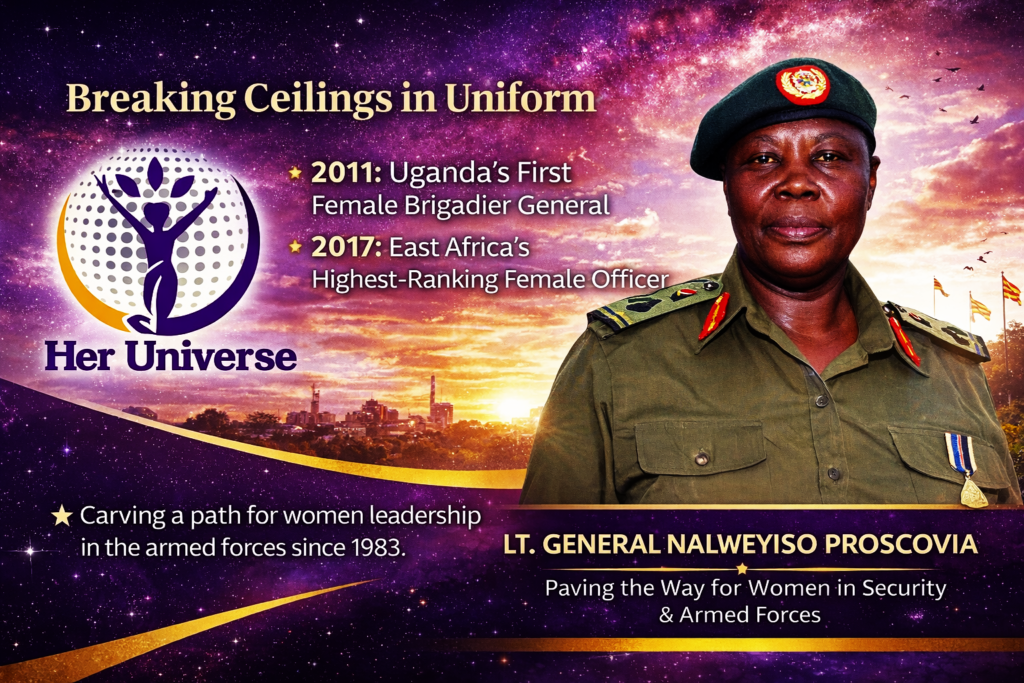
By tracing the arc of one woman’s life, Uganda’s turbulent political history comes sharply into focus. Proscovia Nalweyiso, now a Lt. General, stands as a symbol of endurance, duty, and quiet defiance an educator turned combatant who rose to become one of Africa’s highest-ranking female military officers.
Her story is not one of spectacle. It is a story of survival, shaped by moments when neutrality ceased to exist.
Early Life and the Spark of Resistance
Born in 1954 in Katosi, Mukono District, Nalweyiso trained as a primary school license teacher and later worked as a bursar at Mulerwe Primary School in Mpigi District. Her days revolved around classrooms, ledgers, and children’s futures, until national politics forced its way into her life.
During the 1980 Ugandan presidential elections, Nalweyiso served as a Democratic Party (DP) publicist, mobilising voters and monitoring polling stations to prevent vote rigging. When early reports suggested a DP victory, jubilation rippled across the country. The celebration, however, barely lasted minutes.
Government warnings followed swiftly, threatening arrest for anyone who claimed knowledge of election results outside official channels. That same night, Nalweyiso recalls, persecution and executions began, targeting DP members and other citizens who did not support the Uganda People’s Congress. The UPC soon declared Milton Obote president-elect, an outcome widely disputed by scholars, journalists, and civil society observers.
The promise of democracy flickered and was extinguished before it could take a full breath.
Independent research consistently documents the disputed nature of the 1980 elections, citing intimidation, irregularities, and violence against opposition supporters.
Sources:
- International Crisis Group – Uganda: Understanding the Roots of Political Violence: https://www.crisisgroup.org/africa/great-lakes/uganda
- Makerere Institute of Social Research (MISR) – Election Studies Archive: https://misr.mak.ac.ug
Choosing Resistance When Survival Is at Stake
As violence intensified, Nalweyiso confronted a stark reality: remain passive and risk death, or resist and fight for survival. Like many others at the time, she found the second option less terrifying than the first.
Meanwhile, Yoweri Museveni, then the presidential candidate of the Uganda Patriotic Movement (UPM), traversed the country during the campaign period with a blackboard, teaching citizens about governance, GDP, and national economics. Villagers nicknamed him “the man with the blackboard.”
After the contested election, that same man launched an armed rebellion against the UPC government, marking the beginning of Uganda’s guerrilla war.
Underground Networks and the Work of Women
Nalweyiso soon encountered covert organisers recruiting support for the rebellion operating toward Garamba Forest. Alongside the headteacher and fellow educators at Mulerwe Primary School, she helped establish village, parish, and sub-county secret committees, eventually serving as chairperson or vice chairperson at multiple levels.
These committees became the lifeline of the rebellion. They mobilised food and basic supplies, concealed them at secret drop points, and coordinated movements under constant threat of arrest or execution.
Women often erased from conventional war narratives formed the backbone of logistics, intelligence, and civilian protection. Without them, the resistance would not have survived.
A Note Written on Silver Foil
As arrests and executions escalated, the number of people under Nalweyiso’s protection continued to grow. Constant movements became impossible. In a moment that now reads like historical metaphor, she wrote a brief message on silver foil torn from a cigarette packet, addressing Fred Rwigyema, then a senior commander:
“I cannot keep running with the people I lead when I could protect them with a gun.”
The reply returned on the same scrap of foil. Permission granted.
Nalweyiso joined the guerrilla fighters, exchanging chalk and account books for boots and a rifle
Life in the Bush: The Cost of War
Hope burned brightly at first. Encouragement from leaders such as Moses Kigongo suggested that victory was near. The reality proved far harsher.
What many believed would last months stretched into five punishing years. Life in the bush reduced existence to its bare essentials. Nalweyiso later recalled how women fighters lost so much weight that their bodies seemed to erase familiar contours. Sanitary supplies were nonexistent. Stress and deprivation disrupted menstrual cycles entirely.
War did not only scar landscapes. It rewrote bodies.
Research on gender and armed conflict confirms these experiences. Studies show that women combatants in prolonged conflicts face acute reproductive health challenges, nutritional deprivation, and long-term physical consequences.
Sources:
- UN Women – Women, War and Health: https://www.unwomen.org/en/what-we-do/peace-and-security
- African Centre for the Constructive Resolution of Disputes (ACCORD) – Gender and Armed Conflict in Africa: https://www.accord.org.za
Breaking Ceilings in Uniform
In 1983, Nalweyiso became the first Commandant of the National Resistance Army’s women’s wing, formally carving out institutional space for women inside a male-dominated force.
Decades later, history repeated itself:
- 2011: Uganda’s first female Brigadier General
- 2017: Promoted to Major General, becoming at the time the highest-ranking female military officer in East Africa and the third highest in Africa
Her ascent mirrored a broader, though still incomplete, recognition of women’s leadership in Africa’s security sectors.
A Life of Service, Not Myth
Today, Major General Proscovia Nalweyiso stands not as a legend carved in marble, but as a living record of Uganda’s contradictions, education and violence, hope and loss, resistance and statehood.
Her story reminds us that history often turns on quiet decisions made by ordinary people when survival leaves no neutral ground.
She did not set out to be extraordinary.
She set out to be free.
In doing so, she reshaped the meaning of service for generations of Ugandan women.
